
Ganglion Cyst Treatment: Observation, Aspiration or Surgical Removal?
Learn when a wrist or hand ganglion cyst can be observed, aspirated or surgically removed and why recurrence can occur after treatment.
A ganglion cyst can appear as a visible lump on the wrist or as a deeper source of discomfort that changes with activity. Because these fluid-filled cysts are usually benign, finding one does not automatically mean it must be removed.
Treatment depends on confidence in the diagnosis, pain, functional limitations, location and the patient’s priorities. Observation, aspiration and surgery each address a different clinical situation.
What is a ganglion cyst?
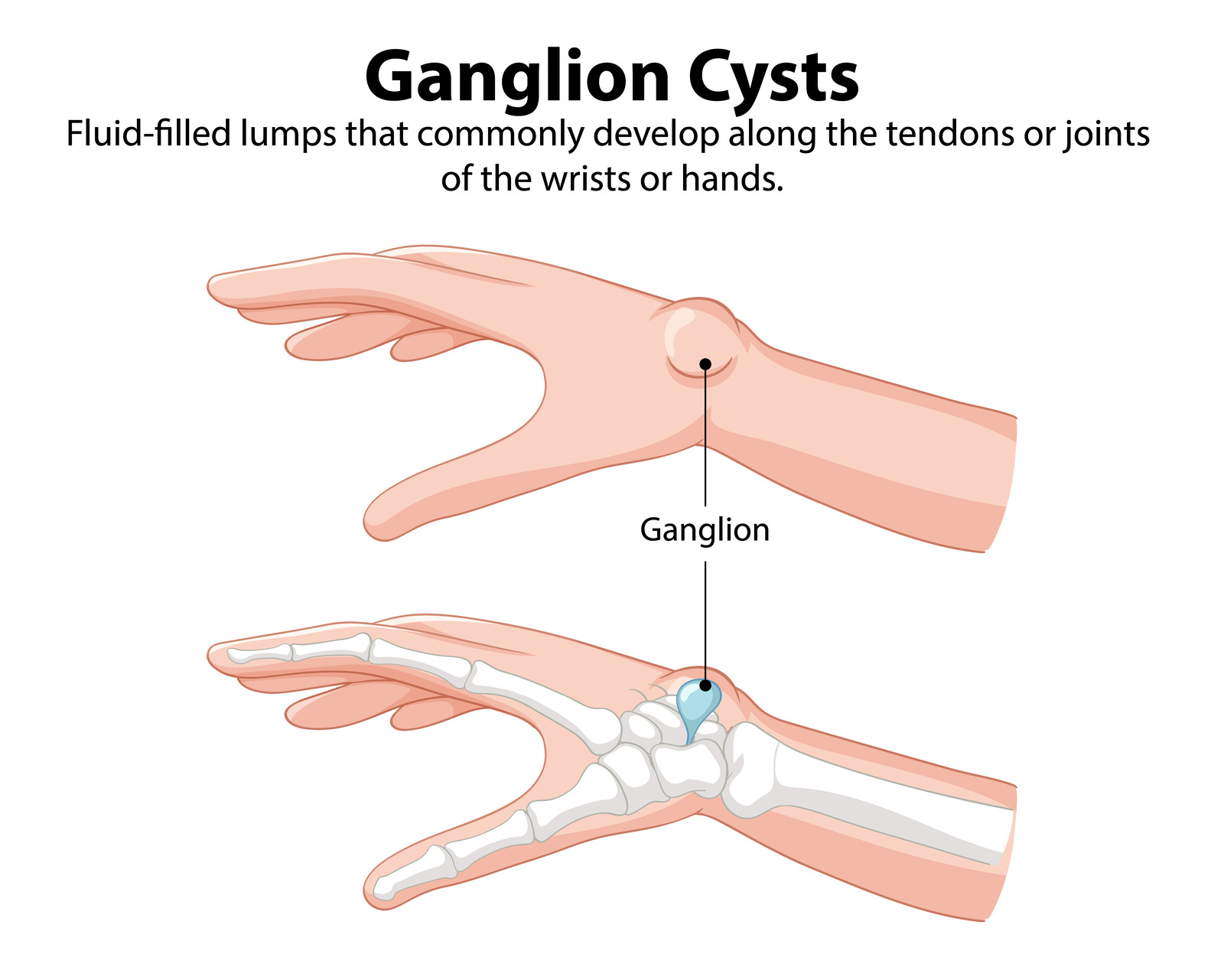
A ganglion is a sac filled with thick, jelly-like fluid arising near a joint or tendon sheath. It is commonly found on the back or palm side of the wrist, although it can occur elsewhere in the hand.
The lump may change in size and can sometimes become less noticeable without treatment. Some cysts are painless. Others produce aching, interfere with wrist extension, become irritated by equipment or create concern because the diagnosis is uncertain.
The size of the lump does not reliably predict how much it will hurt. A small cyst in a confined or sensitive location may be more symptomatic than a larger superficial one.
How is the diagnosis confirmed?
Location, texture and examination findings often suggest a ganglion cyst. Light may pass through some cysts, and the lump may feel connected to a joint or tendon pathway.
Imaging is not required for every typical, painless ganglion. X-rays can show nearby bone or joint changes but do not display the fluid-filled cyst itself. Ultrasound can help distinguish a cystic structure from a solid mass, while MRI may be useful when the cyst is deep, occult or diagnostically uncertain.
A lump that is firm, rapidly changing, fixed, associated with neurological symptoms or otherwise atypical should not be assumed to be a ganglion without assessment.
When is observation reasonable?
Observation may be appropriate when the cyst has a typical appearance, causes little or no discomfort and does not interfere with hand or wrist function.
This means monitoring for meaningful change rather than repeatedly pressing or striking the lump. The traditional idea of hitting a ganglion with a heavy object can injure surrounding tissues and is not an appropriate treatment.
Reassessment is sensible if the mass grows, becomes painful, changes character or begins to affect movement, strength or sensation.
What happens during aspiration?
Aspiration uses a needle to remove fluid from the cyst. It may reduce the size of an accessible cyst and can be performed with ultrasound guidance in selected situations.
The limitation is structural: aspiration removes fluid but usually leaves the cyst wall and connection to the joint or tendon sheath. The cyst can therefore refill. Thick contents or proximity to important nerves and blood vessels can also make some cysts poor candidates for aspiration.
Aspiration on the palm side of the wrist requires particular caution because the radial artery and other important structures may lie close to the cyst.
When may surgical removal be considered?
Surgery may be discussed when a confirmed ganglion causes persistent pain or functional limitation, recurs after aspiration, compresses a nearby structure or remains concerning despite appropriate assessment.
The operation removes the cyst and addresses its stalk or attachment. Depending on location, removal may be performed through an open or arthroscopic approach. The anatomy and suspected origin determine the technique; the smallest visible incision is not the only consideration.
Even after complete surgical removal, recurrence remains possible. Surgery also introduces risks that are not present with observation.
What are the risks and recovery considerations?
Potential risks include infection, scar sensitivity, stiffness, injury to nearby nerves or blood vessels, persistent pain and recurrence. Removing a cyst does not necessarily correct every source of wrist pain if arthritis, ligament injury or another condition is also present.
Recovery depends on location, surgical approach and work demands. Light hand use and forceful loading should be treated as separate milestones. A person who works at a keyboard will have different requirements from someone who bears weight through the wrist or uses heavy tools.
Is a mucous cyst the same thing?
A digital mucous cyst is related to a ganglion but usually develops near the end joint of a finger and is often associated with osteoarthritis. Thin skin, nail changes and communication with the joint create distinct treatment considerations.
That difference is clinically important: a fingertip cyst with broken skin should not be managed as if it were an uncomplicated dorsal wrist ganglion.
Ganglion cyst treatment in Montreal
The first question is whether a lump is truly a ganglion cyst. Once the diagnosis and source are clear, the discussion can balance symptoms, recurrence risk and the trade-offs of observation, aspiration or removal.
If a hand or wrist lump is painful, changing or limiting activity, schedule a consultation with Dr. Daniel Durand to discuss diagnosis and appropriate treatment options.