
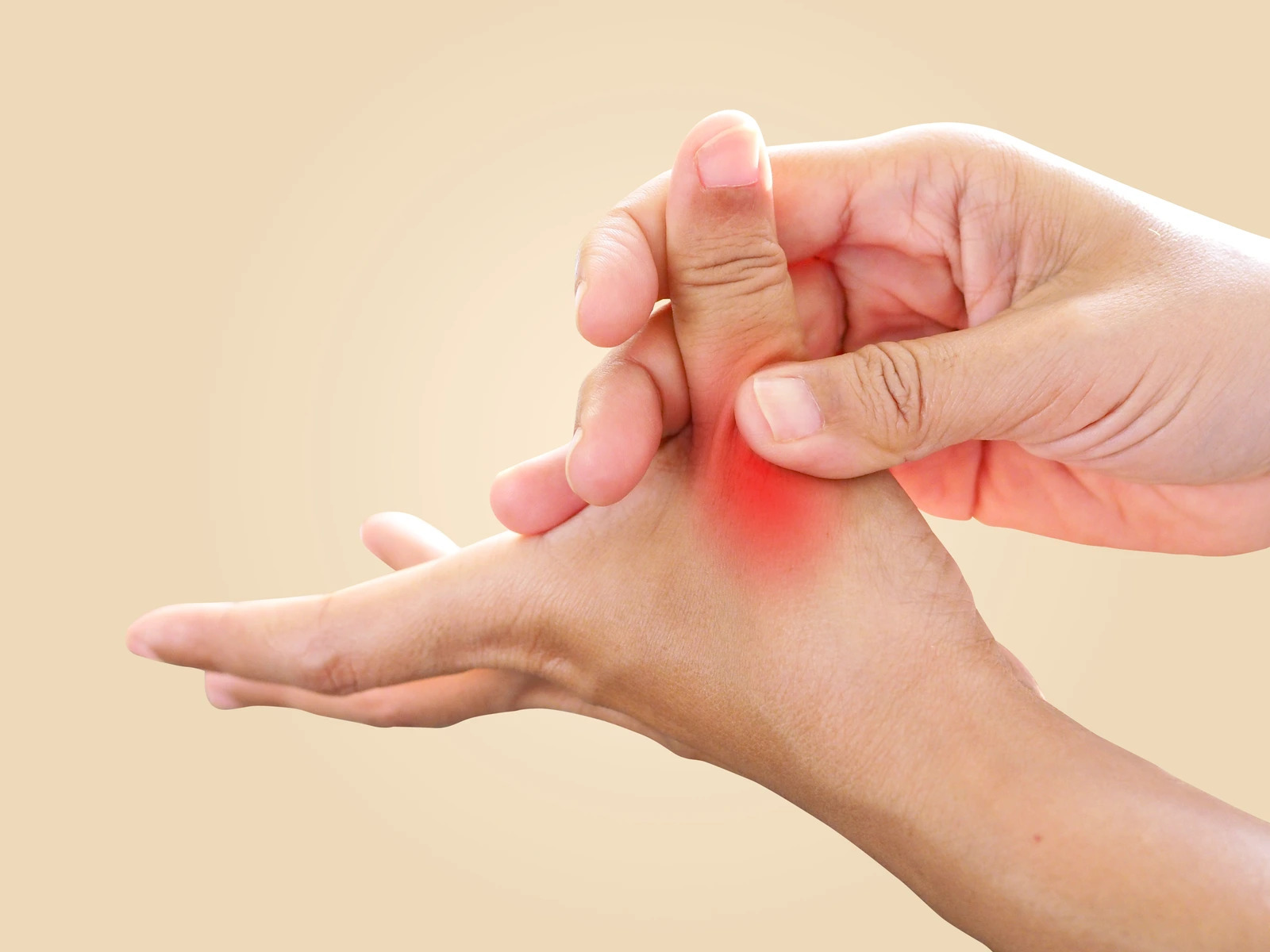
Can Trigger Finger Go Away on Its Own or Is It Likely to Get Worse?
Can mild trigger finger improve without surgery? Learn why symptoms fluctuate and when persistent locking should be assessed in Montreal.
Trigger finger can be confusing because its symptoms are not always constant.
For several days, a finger may click almost every time it bends. The problem may then lessen, creating the impression that it is resolving. A few weeks later, the locking can return and may be more pronounced than before.
This irregular course naturally raises the question of whether to wait or have the finger assessed.
The answer depends largely on how often triggering occurs, the degree of pain, whether the finger can straighten fully and how the problem is evolving.
Why does the finger catch?
The flexor tendons allow the fingers to close and form a fist. To remain close to the bones as they move, these tendons pass beneath several structures known as pulleys.
In trigger finger, the tendon has difficulty gliding through one of these areas, frequently near the base of the digit.
The tendon may still pass through, but with resistance. This mechanism can produce a click or sudden triggering as the finger bends or straightens.
As passage becomes more difficult, more force may be needed to complete the movement.
Why can symptoms come and go?
Irritation around the tendon is not necessarily the same every day.
A period of rest or a temporary change in activities may make the finger less symptomatic. Conversely, certain manual activities may increase discomfort or locking.
The morning is often particularly revealing. After several hours of inactivity, the finger may feel stiffer and catch during its first movements.
Temporary improvement alone therefore does not establish that the mechanism causing the triggering has completely returned to normal.
When is it reasonable to monitor the problem?
Mild, recent symptoms do not necessarily mean surgery is required.
When the finger retains its full range of motion and episodes are occasional, conservative options may be discussed depending on the clinical circumstances.
The choice depends in part on the duration of symptoms and their effect on use of the hand.
Progression deserves more attention: the click becomes more frequent, the finger begins locking regularly or the opposite hand is needed to straighten it.
Can a finger remain locked?
Yes, in more advanced cases.
The tendon may encounter enough resistance for the finger to remain temporarily bent. Some patients can still actively unlock it, while others need to use their opposite hand.
A finger that can no longer straighten fully presents a different situation from an occasional click.
Prolonged stiffness can also complicate finger function. Complete locking should not be treated as a mandatory threshold before seeking an assessment.
Injection or surgical decompression?
Treatment is not the same for every patient.
An injection may be considered in certain situations. When symptoms persist, recur or cause significant locking despite conservative measures, surgical decompression may be discussed.
The procedure releases the area restricting tendon gliding.
Its objective is therefore not to alter the finger joint but to allow the tendon to move with less restriction.
When should trigger finger be assessed?
An isolated, painless click does not necessarily have the same significance as a finger that locks every day.
Assessment becomes especially relevant when the problem persists, becomes painful, limits work or everyday activities, or regularly requires the other hand to unlock the finger.
Dr. Daniel Durand treats trigger finger and a range of tendon, nerve and joint conditions in patients from Montreal, Laval, Châteauguay and surrounding communities.
If your finger is catching or locking more often, an assessment with Dr. Daniel Durand can help establish its severity and identify appropriate treatment options.