
Digital Mucous Cyst Treatment: When a Fingertip Lump Affects the Joint or Nail
Learn why mucous cysts form near the fingertip joint, how they affect the nail and when observation or surgical treatment may be considered.
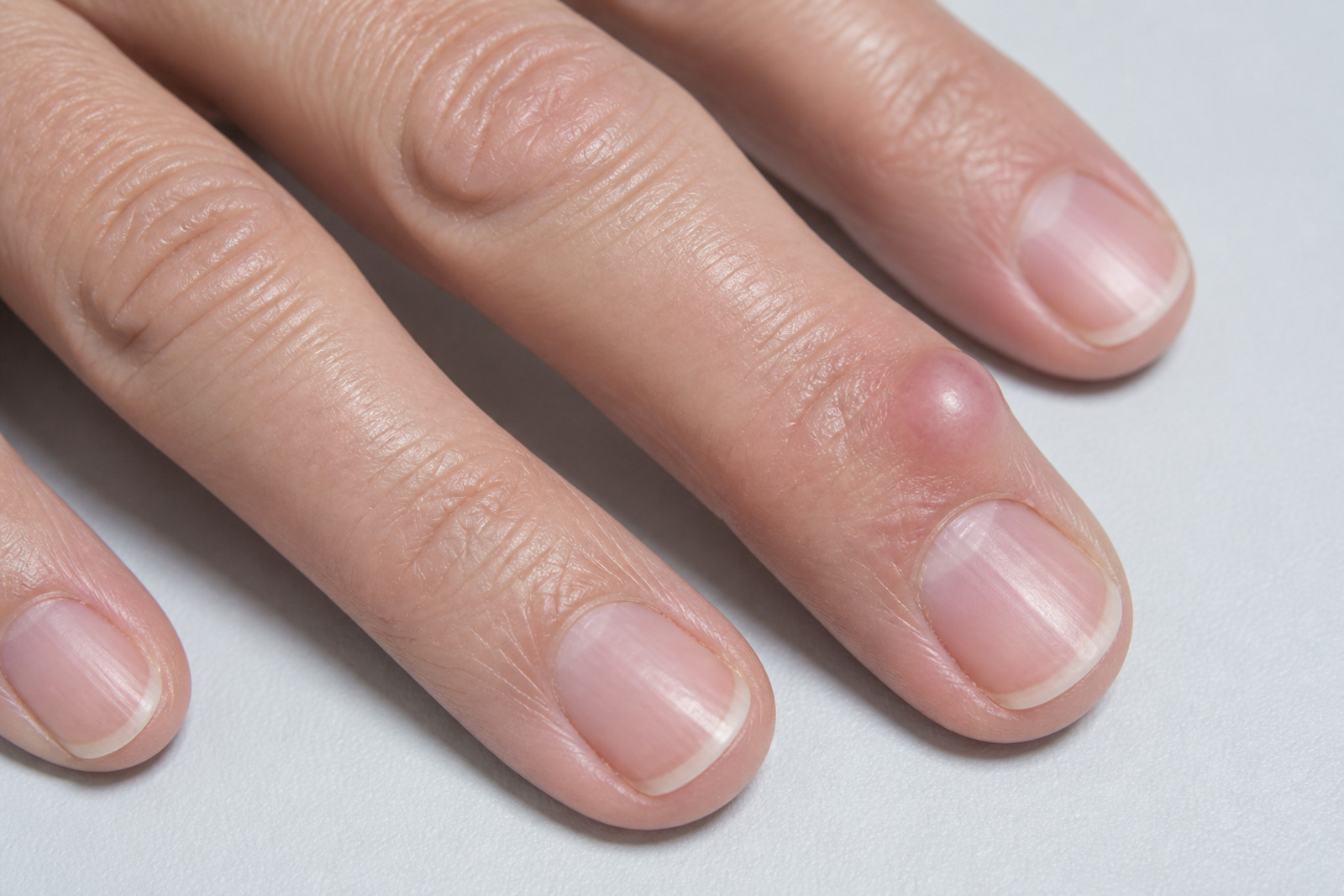
A small bump near the end joint of a finger may look harmless, but a digital mucous cyst has features that distinguish it from a typical wrist ganglion. It often communicates with an arthritic joint, can deform the nail and may stretch the overlying skin until it becomes fragile.
Those relationships—to the joint, nail and skin—help determine whether the cyst can be observed or needs treatment.
What is a digital mucous cyst?
A mucous cyst is a fluid-filled sac that usually develops beside the distal interphalangeal joint, the joint closest to the fingernail. It contains thick joint-like fluid and is commonly associated with osteoarthritis and small bone spurs.
The cyst may appear translucent or skin-coloured. Some cause little discomfort, while others become tender when bumped or interfere with everyday hand use.
Despite the name, the cyst does not contain respiratory mucus. It is more closely related to a small ganglion arising near the fingertip joint.
Why can the fingernail change?
The tissue that produces the nail lies close to the joint and cyst. Pressure in this area can create a groove or ridge along the nail plate.
The nail change may persist while the cyst remains and can take time to grow out after the pressure is addressed. A nail deformity can also have other causes, so the presence of a groove does not confirm a mucous cyst on its own.
Assessment looks at the lump, skin, nail and underlying joint rather than treating these as separate problems.
Can a painless mucous cyst be observed?
Yes. Observation may be reasonable when the diagnosis is clear, the cyst is not painful, the skin remains healthy and the finger functions normally.
Patients should avoid puncturing, cutting or repeatedly draining the cyst at home. Because it can communicate with the joint, an opening in the skin may create a pathway for bacteria.
Changes that deserve prompt attention include increasing redness, warmth, drainage, escalating pain or a break in the skin that does not seal. Infection near a joint can become serious and requires appropriate medical assessment.
Is aspiration appropriate?
Needle drainage can reduce the size of some cysts, but recurrence is common because the cyst wall and connection to the joint may remain. The thin skin and proximity of the nail-producing tissue also require care.
Treatment should not be chosen solely because aspiration sounds simpler. The condition of the skin, the cyst’s location, underlying arthritis and previous recurrence all affect whether it is reasonable.
Home drainage is especially problematic because it lacks sterile technique and does not address a possible joint connection.
What does surgical treatment address?
Surgical treatment may remove the cyst and its stalk and address an associated bone spur when clinically appropriate. The aim is to reduce recurrence while protecting the nail matrix, tendon and skin.
In some cases, the overlying skin is too thin for straightforward closure and may need a local skin procedure. The exact plan depends on cyst size, skin quality, nail changes and the condition of the joint.
Surgery treats the cyst but does not reverse all arthritis within the distal finger joint. Joint stiffness or aching related to osteoarthritis can therefore remain even when the lump is removed.
When is surgery considered?
Removal may be discussed when the cyst repeatedly drains, threatens the skin, causes pain, creates a substantial nail deformity or returns after other treatment. Diagnostic uncertainty is another reason to assess rather than repeatedly drain a fingertip mass.
The balance is different for a stable painless cyst with healthy skin. In that setting, the risks and recovery of surgery may outweigh the benefit of removing a visible bump.
What are the risks and recovery issues?
Potential risks include infection, delayed wound healing, scar sensitivity, stiffness, nail deformity, injury to nearby structures and recurrence. Thin or damaged skin can make healing more complex.
The finger may need protection while the incision heals, followed by movement according to the surgeon’s instructions. Work involving wet environments, repeated fingertip pressure or contamination may require different planning from desk-based work.
Frequently asked questions
Is a mucous cyst cancerous?
A typical digital mucous cyst is benign. However, not every fingertip lump is a mucous cyst, so an atypical, solid or changing mass should be examined.
Will removing the cyst cure finger arthritis?
No. Treatment can address the cyst and associated local anatomy, but it does not remove the overall tendency toward osteoarthritis in the joint.
Mucous cyst care in Montreal
Good treatment planning accounts for more than the size of the bump. Skin integrity, nail growth, joint arthritis and the effect on function all matter.
If a fingertip cyst is painful, draining or affecting the nail, schedule a consultation with Dr. Daniel Durand to discuss the diagnosis and whether observation or surgical treatment is appropriate.